
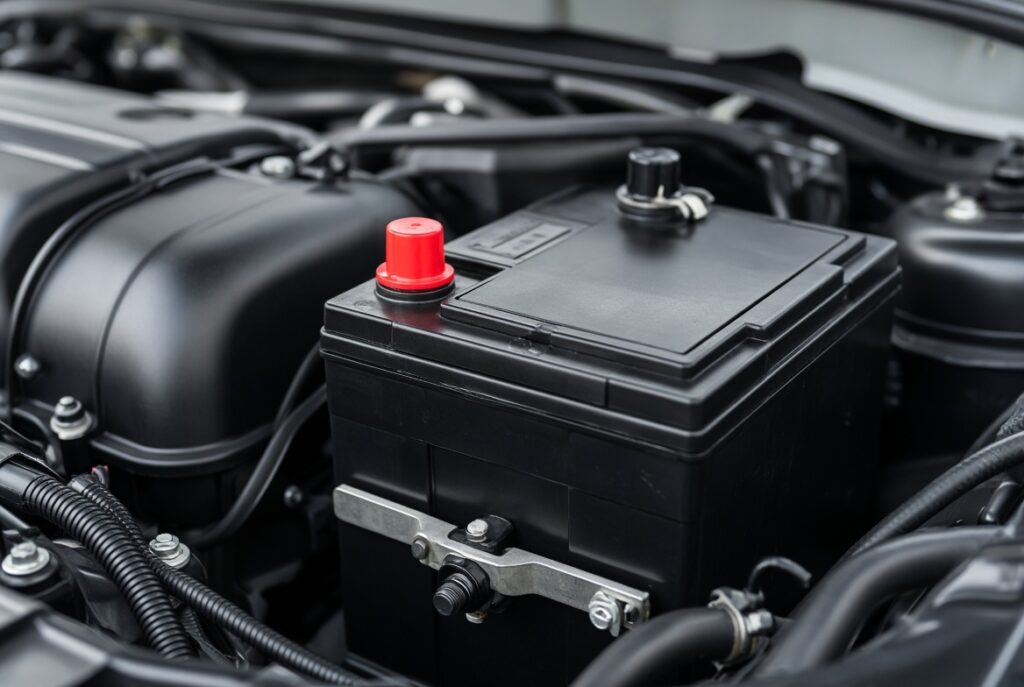
The $200 Battery That Can Disable a $60,000 Car
Most people assume the expensive battery in a modern car is the big one. In an EV, that is the high-voltage pack under the floor. In a hybrid, it is the traction battery. In a conventional car, it is easy to think the starter motor is the only thing that matters.
The part that actually shuts the vehicle down is usually smaller, cheaper, and older in design: the 12-volt battery. When a 12-volt battery replacement is overdue, a Tesla can refuse to open its doors. A late-model Hyundai or Kia EV can sit with a full charge and still go dark. A gas sedan with start-stop and keyless entry can look as if it has a major electrical problem when the real issue is a $150–$250 battery that has simply aged out.
That is not a quirk. It is how the industry still designs cars.
Why 12-Volt Battery Replacement Still Matters in EVs
The high-voltage pack in an EV or plug-in hybrid typically runs at 400 or 800 volts. That is useful for moving the car. It is a poor way to run door latches, headlights, instrument clusters, radios, and the computers that wake the rest of the vehicle.
Carmakers kept a separate 12-volt circuit because it is cheaper, safer, and already supported by a vast parts ecosystem. The small battery powers the low-voltage electronics. In an EV, a DC-DC converter steps energy down from the traction pack to keep that 12-volt battery charged. In a gas car, the alternator does the same job.
The critical point is this: the high-voltage system often cannot come online until the 12-volt system is alive. No 12 volts, no wake-up command, no drive. Features that run while the car is parked make the job harder. Keyless entry, telematics, cameras, and security modes keep drawing current. Leave the vehicle sitting for two or three weeks, especially with an aging battery, and the reserve disappears.
How Often a 12-Volt Battery Replacement Is Needed
There is no single interval, but the ranges are consistent enough to plan around.
- Conventional flooded lead-acid batteries typically last 3 to 5 years.
- AGM (absorbent glass mat) batteries, common on start-stop and many luxury and EV models, often last 4 to 7 years.
- Enhanced flooded batteries (EFB), used on many start-stop cars, generally last 4 to 6 years.
- A small number of EVs now use a lithium-ion 12-volt pack, which can last longer but is more expensive and less interchangeable.
Climate matters more than mileage. Heat is harder on a battery than cold starts. In Arizona, Texas, or inland Southern California, many batteries fail in 2 to 3 years. In milder climates, 5 years is common. Short trips, parked electronics, and repeated deep discharges shorten life further.
A practical rule: test after year three. Plan a 12-volt battery replacement at year four or five if the vehicle is used daily and you cannot afford a no-start. Do not wait for a complete failure in an EV. The symptoms are not always a slow crank. They can be a car that will not unlock, a screen that stays black, or a high-voltage system that never wakes.
This is also why a mileage-only service plan is incomplete. A 12-volt battery belongs on the same calendar as cabin filters and brake fluid, not just the odometer. See our car maintenance schedule by mileage for where it fits alongside other wear items.
Typical Warranty on a 12-Volt Battery Replacement
Two warranties get confused.
The new-car bumper-to-bumper warranty may cover the original 12-volt battery, but often only for 2 to 3 years or a mileage cap. After that, the battery is treated as a wear item.
The replacement battery has its own warranty, and that is the one that matters after the first few years. Typical aftermarket coverage looks like this:
- Economy flooded batteries: about 18 to 24 months free replacement.
- Mid-range batteries: about 36 months free replacement.
- Premium AGM batteries: often 36 to 48 months free replacement, sometimes with a longer prorated period after that.
“Prorated” means you get a discount on the next battery, not a free one. A label that says “5-year warranty” frequently means 3 years free and 2 years of partial credit. Commercial use, improper charging, and installing the wrong chemistry can void the claim. Keep the receipt. Many claims require proof of purchase and a load test showing the battery failed.
OEM vs Aftermarket: Is a Dealer 12-Volt Battery Better?
The dealer battery is not automatically better. It is often the same chemistry, in the same group size, from one of the large manufacturers that also supply the aftermarket. What you are paying for is fitment certainty, programming on some vehicles, and the dealer’s installation process.
A quality aftermarket battery is usually the better value if three things match:
- Chemistry. If the car was built for AGM, do not install a cheap flooded battery. The charging system is calibrated differently.
- Group size and terminals. The case has to fit the tray and hold-down. The posts have to match the cables.
- Cold-cranking amps (CCA) and reserve capacity. Meet or slightly exceed the original specification.
Brands such as Interstate, DieHard, Optima, Bosch, and ACDelco regularly match OEM performance at a lower installed price. The weak aftermarket choice is the cheapest flooded unit in a vehicle that needs AGM or EFB. For a broader framework on that decision, see OEM vs aftermarket vs used parts.
Some late-model cars need a registration or reset after replacement so the charging system recognizes the new battery. That is a shop procedure, not a reason to default to the dealer part. It is a reason to use a shop that knows the vehicle.
Cost comparison is usually straightforward. A dealer 12-volt replacement on a modern car or EV often lands in the $250 to $450 range installed. A correct aftermarket AGM, installed at an independent shop or parts store, is commonly $180 to $320. The gap is labor and markup more than chemistry. Used batteries are a poor bet here. This is a new-part job.
How to Choose the Right 12-Volt Battery Replacement
Start with the vehicle, not the display rack. The VIN is the cleanest way to lock the correct group size, chemistry, and application. Year-make-model alone misses mid-year changes and start-stop variants. If you need a refresher, see how to read a VIN.
Once the spec is clear, compare OEM and aftermarket options side by side rather than guessing from a shelf label. A VIN-based search on PartsHaggler is a practical way to identify the correct battery first, then decide where to buy it. For more on speeding up that process, see 7 ways DIYers can find auto parts faster.
The Takeaway
The 12-volt battery is still the gatekeeper of the modern car. It is a wear item with a 3- to 5-year life in most applications, a shorter life in heat, and a warranty that is usually 2 to 4 years of free replacement — not the longer number printed in large type.
OEM from the dealer is rarely a performance upgrade. It is a convenience purchase. A correct aftermarket AGM or EFB from a reputable brand is usually the smarter spend, provided the chemistry and group size match. Treat 12-volt battery replacement like brake pads: replace it on a schedule, not after the car leaves you in a parking lot.
Related reading: Complete Car Maintenance Schedule by Mileage, OEM vs Aftermarket vs Used Parts, and How to Read a VIN.
Need the correct 12-volt battery for your vehicle?
Go to PartsHaggler.com and search by VIN — or view plans on the levels page.