
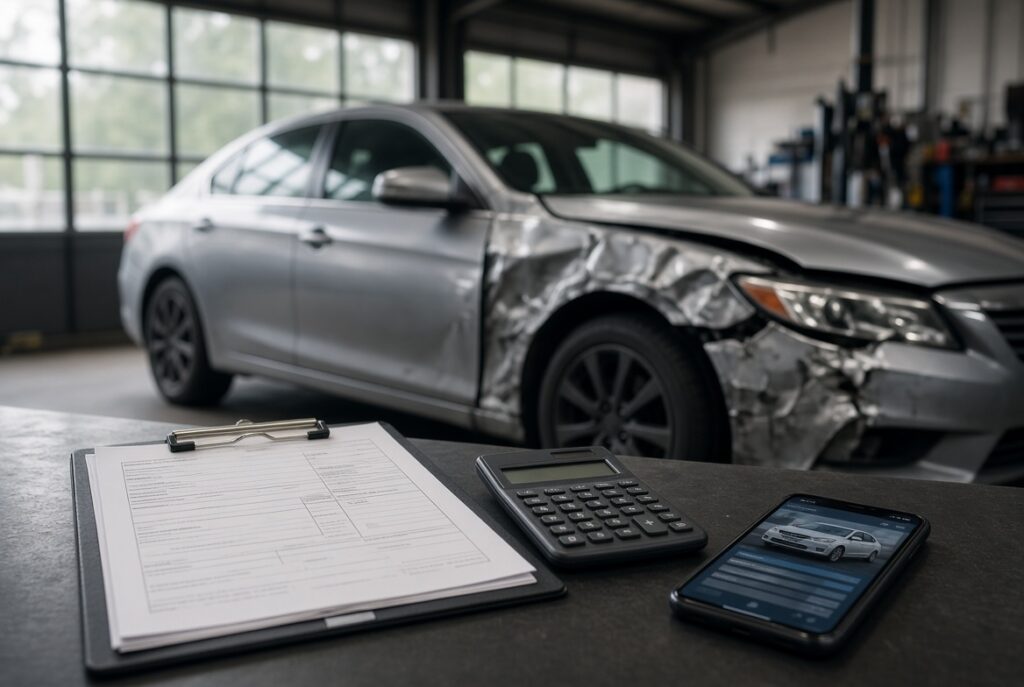
Insurance claim vs out of pocket is one of the most important decisions drivers face after an auto accident. The estimate arrives with the usual mix of precision and ambiguity — a front bumper, a headlight assembly, a fender, labor, paint, and miscellaneous fees. The total often sits just high enough to force a choice most people would rather avoid: file an insurance claim or pay for the repairs themselves.
It is a calculation that involves more than the number on the page. Deductibles, potential rate increases, the age of the vehicle, and the real cost of replacement parts all shape the outcome. Yet many vehicle owners make the choice with incomplete information, often defaulting to their insurance company without examining whether that path is actually cheaper or smarter.
Here is a clearer way to evaluate the insurance claim vs out of pocket decision.
Insurance Claim vs Out of Pocket: The Numbers That Actually Matter
Three variables dominate the analysis.
First is the gap between the repair estimate and your deductible. If the estimate is only modestly higher than the deductible, filing a claim may save little money after the deductible is applied. In some cases, the net savings can be smaller than the long-term cost of a claim on your record.
Second is the likelihood of a rate increase. Insurers weigh claims differently depending on whether the driver was at fault, the size of the payout, and the driver’s prior history. A single modest claim can raise premiums for three years or longer in many states. That increase often exceeds the short-term savings of filing.
Third is the actual cost of the parts. Estimating systems used by many shops and insurers default to OEM pricing. In practice, quality aftermarket or carefully selected used parts can reduce the total significantly, especially on body panels, lights, and bumpers. The difference is frequently large enough to change the math.
When Filing a Claim Usually Makes Sense
There are clear situations in which using insurance is the rational choice.
High repair costs relative to the deductible favor a claim. When the estimate is several times the deductible amount, the immediate out-of-pocket burden of paying yourself becomes substantial. Injuries, structural damage, or clear liability by another party also strengthen the case for filing. In those instances, the insurance mechanism exists precisely to absorb large, unpredictable costs.
A clean claims history and a low deductible further tip the scale toward filing. Drivers who have not filed a claim in years may face limited or no rate impact, particularly if the accident was not their fault.
When Paying Out-of-Pocket Is Often the Better Path
The opposite conditions favor writing a check.
When the repair estimate sits close to the deductible, the net benefit of filing shrinks. Add the possibility of higher future premiums, and the economics often favor paying directly. This is especially true for older vehicles, cosmetic damage, or situations in which the owner can source parts at a meaningful discount.
Minor collisions that affect only exterior panels frequently fall into this category. A front bumper and headlight combination that totals $2,800 against a $1,000 deductible looks different once quality used or aftermarket options bring the parts cost down by several hundred dollars. Suddenly the gap narrows, and the long-term insurance consequences loom larger.
How Parts Pricing Changes the Equation
The availability of accurate, multi-source pricing has altered the traditional calculation. Body shops and vehicle owners who rely solely on insurer or estimating-system prices often see only one version of the cost. Comparing OEM, aftermarket, and used/LKQ options side by side can reveal a different picture.
In practice, the difference on common collision parts—bumpers, fenders, hoods, headlights, and mirrors—can range from 20% to well over 50%. That reduction does not eliminate the need for proper fitment checks or quality control, but it does change the threshold at which filing a claim becomes advantageous.
Owners who take the time to obtain a realistic parts cost before deciding frequently discover that the out-of-pocket route is more viable than the initial estimate suggested. Tools that aggregate pricing across multiple sources make this comparison far faster than calling individual suppliers.
A Practical Framework for the Decision
A straightforward sequence helps cut through the noise:
- Obtain a detailed repair estimate that separates parts and labor.
- Identify the real cost of the major parts across OEM, aftermarket, and used sources.
- Subtract the deductible from the revised total.
- Estimate the potential three-year impact of a rate increase.
- Compare the two net costs.
If the insurance path still saves a meaningful amount of money after accounting for future premiums, filing is usually the better decision. If the savings are marginal or negative once rate effects are included, paying directly often proves more economical.
Final Considerations
The insurance claim vs out of pocket decision is rarely purely financial. Some owners prefer to keep their insurance record clean regardless of the numbers. Others prioritize minimizing immediate cash outlay. Both approaches are rational when the trade-offs are understood.
What is less rational is making the choice with only the first estimate in hand. The true cost of an accident repair is not fixed. It depends on how the parts are sourced and how the long-term consequences of a claim are weighed. Drivers and shops that examine both sides of that equation tend to make clearer, less expensive decisions.
For more guidance on finding the right parts when OEM options are expensive or delayed, see our related articles on what to do when a part is no longer available and OEM vs aftermarket vs used parts.
For additional perspective on how claims can affect insurance rates, see the guidance from the Insurance Information Institute.