
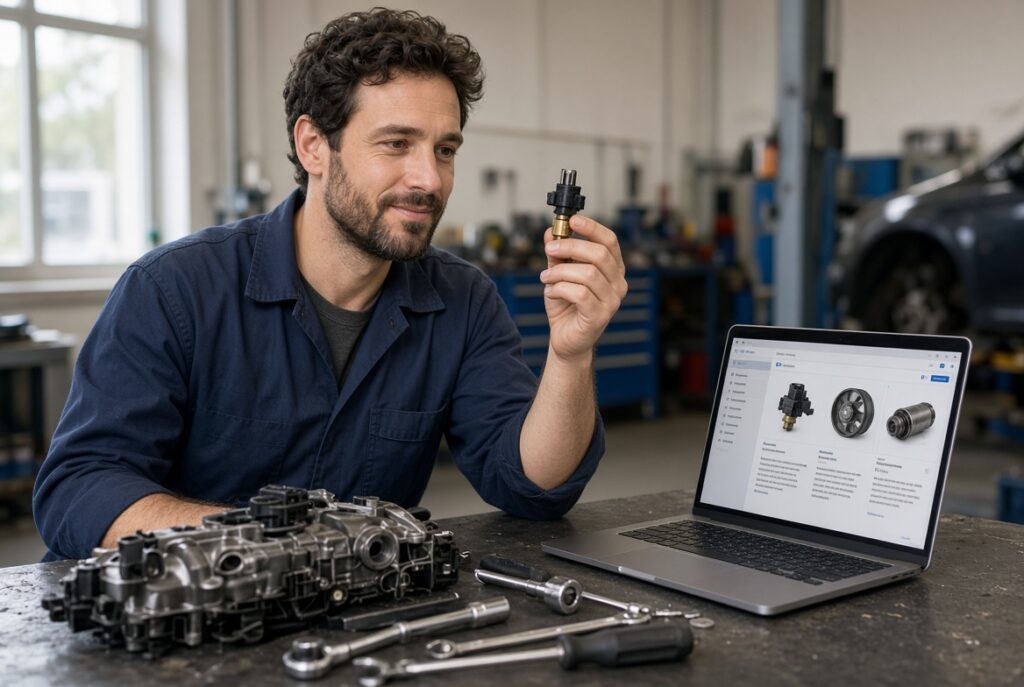
He Fixed a $5,500 Tesla Problem with a $70 Mercedes Part — And What It Teaches Us
OEM part too expensive? Many people assume the repair is no longer practical. In reality, better options often exist if you expand the search beyond the original manufacturer.
A clear real-world example shows why. A Tesla Model S owner was quoted $5,500 for a front drive motor replacement. He fixed the actual problem with a $70 Mercedes-Benz part.
The $5,500 Quote vs the $70 Fix
According to a detailed account published by MotorBiscuit, the owner of a 2015 Tesla Model S received a warning that the front drive motor was disabled. Tesla’s diagnosis pointed to the drive unit, and the quoted replacement cost was $5,500.
Further diagnosis revealed the real issue was a failed encoder sensor. Tesla does not sell the sensor separately and treats the entire drive unit as a non-serviceable assembly.
The working solution came from a related vehicle: the Mercedes-Benz B-Class Electric Drive, which used Tesla-sourced drivetrain components. The encoder sensor was available from a Mercedes dealer for about $70. After replacement, the car ran normally again.
Total parts cost for the repair was roughly $140. The savings exceeded $5,300.
This Kind of Cross-Brand Sharing Is More Common Than Most People Think
The Tesla–Mercedes example is striking, but it is not unique. Automakers and suppliers routinely share components across brands and platforms. Here are several well-documented cases:
- Tesla and Mercedes-Benz — Early Model S and Model X vehicles used Mercedes steering column stalks, window switches, and other switchgear.
- Toyota, Lexus, and Pontiac — Many Camry parts interchange with the Lexus ES. The Toyota Corolla and Matrix also share significant components with the Pontiac Vibe.
- Honda and Acura — Civic and ILX models, as well as Accord and TSX models, share large numbers of mechanical and body parts.
- Volkswagen Group — VW, Audi, Skoda, and Seat share extensive platforms (such as MQB). Engines, transmissions, suspension components, and electronics frequently cross over between these brands.
- McLaren and Mercedes-Benz — Some McLaren models used Mercedes window motors.
In addition, major suppliers such as Bosch and Denso provide the same or nearly identical components to multiple manufacturers. The result is that a part sold under one brand’s label is often available under another — sometimes at a very different price.
When an OEM Part Is Too Expensive
Situations like these appear with older vehicles, limited-production models, discontinued body parts, and sensors that are only sold as part of a larger assembly.
In these cases, the practical path is usually:
- Confirm the exact failed component (not just the assembly)
- Search by VIN and application for interchangeable options
- Check related platforms or supplier-shared parts
- Evaluate quality used or aftermarket alternatives
- Only then consider full OEM assembly replacement
This is exactly the kind of problem PartsHaggler is built to help with — running a deeper search across new, used, and alternative sources instead of stopping at the first high OEM price.
Key Takeaway
When an OEM part is too expensive, the solution is rarely to give up. It is to search more broadly — across applications, related platforms, used inventory, and alternative suppliers. PartsHaggler helps surface options that single-site searches often miss. See more practical guides in our Articles section.
How This Applies to Everyday Repairs
Most people will not run into a Tesla encoder sensor. But the same pattern appears with more common vehicles:
- A sensor only available as part of a larger module
- A body panel that is discontinued in OEM but still available used or aftermarket
- A part number that has been superseded without clear documentation
- An assembly quote that is disproportionate to the actual failed component
In all of these cases, starting with a wider search — rather than accepting the first high OEM price — often leads to a better outcome. PartsHaggler lets you search by vehicle, description, photo, or VIN across multiple types of sources in one place.
Start With a Better Search
If you regularly deal with high OEM quotes or hard-to-find parts, it pays to use a tool built for deeper search. You can start free on PartsHaggler.com and upgrade when you need higher limits, My Garage, Voice Search, Photo Analysis, and Technical Documentation.
Compare plans and features on the membership levels page.
Final Thoughts
The Tesla owner who fixed a $5,500 problem with a $70 Mercedes part did not find a “hack.” He found a legitimate, application-compatible component that the original manufacturer chose not to sell separately.
When an OEM part is too expensive or unavailable, the same principle applies: expand the search, check related applications, and evaluate real alternatives before defaulting to the highest-cost option.
Related reading: What to Do When the Part You Need Is No Longer Available and OEM vs Aftermarket vs Used Parts.
Need to look beyond the first OEM quote?
Go to PartsHaggler.com and start searching — or view plans on the levels page.